
How does a registered trademark help defend against cyberattacks? A guide to NIS2 Directive compliance
Learn how a registered trademark can support cybersecurity and NIS2 compliance by helping companies detect and respond to phishing, fake domains and online brand abuse at an earlier stage.
F. Trpeski
7/9/20267 min read
The NIS2 Directive, cybersecurity for businesses and trademark protection are connected much more closely than most companies assume. In this guide, we explain why a registered trademark is becoming an important part of a digital compliance strategy and how an integrated approach to intellectual property and IT security helps companies protect themselves against phishing, fake domains and brand abuse.
It is worth noting that in Macedonian legislation, the NIS2 Directive has been transposed through a special law, namely the Law on Security of Network and Information Systems (Official Gazette of the Republic of North Macedonia, No. 135 of 4 July 2025).
Key points of this article:
NIS2 requires active management of digital risks and response within very short deadlines
A registered trademark is proof of ownership that can accelerate the removal of fake domain names and malicious profiles
Phishing attacks abuse trust in brands, while legal protection strengthens the defence
Why is a trademark no longer only legal protection?
When people talk about the NIS2 Directive, they usually think of servers, passwords, data backups and technical protection measures. But modern cyberattacks are not aimed only at IT infrastructure. Attackers increasingly abuse a company’s reputation, name and brand in order to deceive clients, suppliers and employees.
This is why cybersecurity for businesses today is not only an IT issue. It also includes trademark protection, digital compliance and an integrated approach to intellectual property and IT security.
Cybercriminals do not attack only the system. They also attack the brand
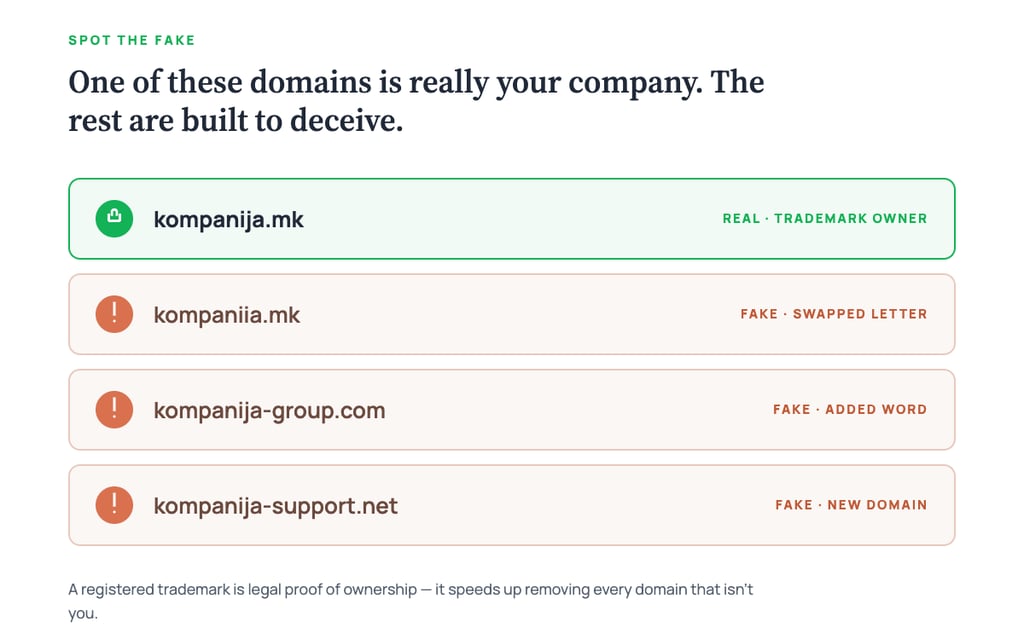
Imagine that someone registers an internet domain that looks very similar to the name of your company, for example:
On such websites, fake invoices, fake offers, password collection forms, a copy of your website or fake payment pages may be placed.
The client believes that they are communicating with your company because they recognise the logo, the name and the visual identity. In reality, your brand itself becomes the tool through which the attack is carried out.
How does the IP approach complement classical cybersecurity?
Classical cybersecurity most often protects the system: computers, servers, email, passwords and data. But phishing attacks often start outside the system. The attacker may first register a domain that closely resembles the name of your company, create a fake website or open a profile that appears to be connected with your brand.
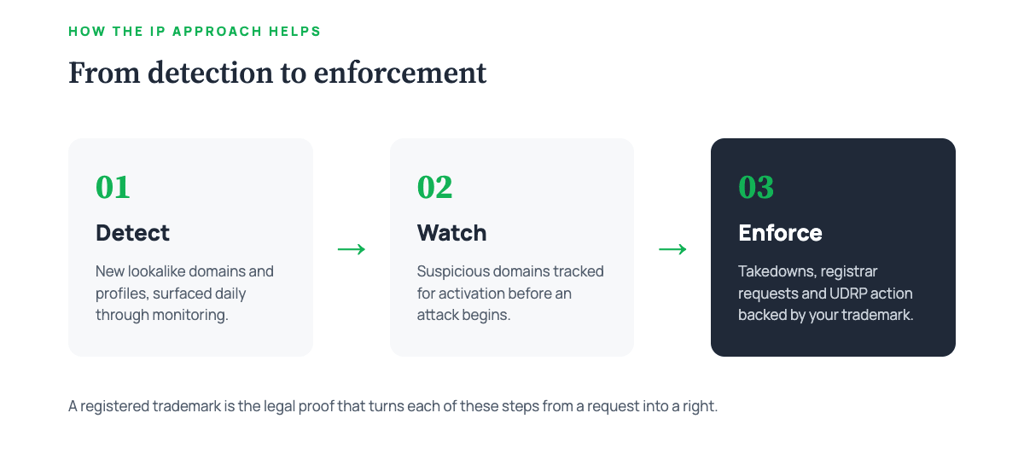
This is where the IP approach, that is, protection of intellectual property, helps. If the company has a registered trademark, it has strong proof that the brand belongs to it. This enables a faster response when a suspicious domain, fake website or profile imitating the brand appears.
For example, if someone registers a domain that looks very similar to your brand, it is not always necessary to wait for a phishing attack to happen before the danger becomes visible. If there is a registered trademark and the domain clearly copies or imitates the brand, action can be taken at an early stage after the domain has been registered. This may include a request for the removal, deletion or transfer of the domain, depending on the applicable rules.
In other words, classical cybersecurity reacts when there are technical signs of an attack, such as suspicious emails, abused servers, full email headers, SPF/DKIM/DMARC results or other technical evidence. The IP approach, on the other hand, helps identify the risk even earlier, by monitoring misuse of the name, logo, domains and digital identity of the brand.
Phishing attacks are most often successful because the victim recognises a familiar brand. Attackers use a similar name, copy a logo, use identical colours and send convincing emails. If the brand is legally protected, the company has a significantly stronger basis for taking legal action.
A registered trademark is strong legal proof that you are the legitimate holder of the rights to the brand. If a third party registers an internet domain that copies or imitates your name, this right significantly facilitates the taking of measures, including requesting the transfer or deletion of the domain, acting before national and international registries, communicating with registrars and hosting providers, and initiating proceedings for the resolution of international domain name disputes under mechanisms such as UDRP and URS, where applicable.
This allows the company to react more quickly and effectively to abuses, reduce the risk of fraud and phishing, and protect the reputation of the brand before greater damage occurs.
What is the connection between NIS2 and trademarks?
NIS2 requires companies to implement mandatory measures such as:
risk management
threat assessment
incident management
protection of digital assets
risk mitigation measures
If a company cannot react effectively when someone abuses its brand, the risk of successful cyber fraud increases significantly. For that reason, a protected trademark becomes part of the broader system for managing digital risks under NIS2.
What does this look like in practice? During our regular monitoring activities, our system collects data that are processed and evaluated according to different parameters, in order to identify potential brand abuses, risky domains and other indicators that may point to the preparation or execution of a cyberattack.
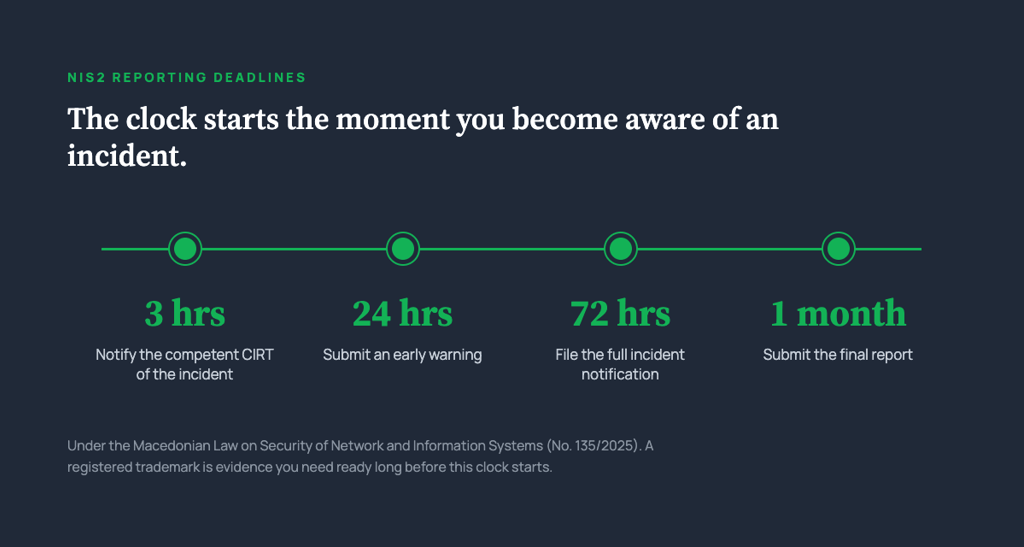
In this way, in addition to preventive action, we provide resources and information that can help with timely reaction and with meeting the statutory deadlines for reporting a significant cybersecurity incident or a significant cyber threat. Under Macedonian law, essential and important entities are required to notify the competent computer incident response team immediately, and no later than three hours from the moment they become aware of the occurrence of the incident and/or cyber threat. In addition, the law also provides for the submission of an early warning within 24 hours, an incident notification within 72 hours and a final report within one month.
Better cooperation with internet service providers
Companies that manage domains, web hosting and e-commerce platforms react significantly faster when there is valid proof of a registered trademark and a report submitted by a professional representative. This can mean the difference between several hours and several weeks in removing malicious content.
One of the basic ideas of NIS2 is for organisations to actively manage risks, identify critical assets, recognise potential threats, establish rapid response procedures and reduce the impact of incidents. The brand is one of the most valuable intangible assets of every company. If the brand can easily be abused, then there is also a significant security risk.
Digital compliance does not mean only fulfilling a legal obligation
Many companies believe that compliance only means preparing documents. In practice, digital compliance means establishing processes that actually reduce risk, including:
a domain management policy
a trademark register
monitoring of brand abuse
incident reporting procedures
a phishing response plan
regular employee training
Practical example
Imagine that there is a company that sells medical equipment and that all hospitals know it by its name and logo.
Now imagine that someone else creates a fake internet domain that looks almost the same as the company’s real domain. The difference may be only one letter. At first glance, people may think that it is the real company.
Then, emails are sent from that fake domain to hospitals. The emails may say, for example, that an invoice should be paid to a new bank account. The hospital may believe that the email is real because the name, the domain and the appearance resemble the company it knows.
If the company does not have a registered trademark, does not monitor the appearance of similar domains and has no plan for what to do in such a situation, the reaction may be slow and the damage significant.
But if the brand is registered as a trademark and the company has monitoring and a response plan in place, it can much more quickly request that the fake domain be removed, notify its clients and take legal steps.
In such situations, time is very important. The earlier the fake domain is detected, the lower the chance that someone will be deceived.
Checklist: Is your company prepared?
Check your level of preparedness with the following questions:
Is your trademark registered?
Do you monitor newly registered domains that resemble your brand?
Do you have a procedure for reporting brand abuse?
Do employees know how to recognise phishing?
Is there a rapid response plan in case of misuse of the company’s logo or name?
Do the legal and IT teams cooperate in risk management?
Do you regularly check your digital exposure?
If the answer to most of these questions is “no”, it is time to start improving your organisational processes.
Frequently Asked Questions (FAQ)
1. Does the NIS2 Directive require trademark registration?
NIS2 requires the management of digital risks and a rapid response to incidents, and a registered trademark is a practical tool that facilitates that management.
2. How does a trademark help against phishing attacks?
It provides a legal basis for the faster removal of fake domains, profiles and content that imitate your brand, thereby reducing the time during which clients are exposed to risk.
3. Which team should be involved in protecting the brand from cyber threats?
An integrated approach is needed: the IT team protects the infrastructure, the legal team protects the trademark, the marketing team monitors reputation, and all of them should cooperate and coordinate risks together.
Conclusion
Cybersecurity has long ceased to be an exclusively technical issue. Today, attackers increasingly abuse the trust that clients have in well-known brands, and that is why legal protection of the brand is becoming an important part of risk management.
The NIS2 Directive requires organisations to establish effective measures for identifying, reducing and managing cyber risks. In this context, trademark protection is not only a matter of intellectual property, but also a practical tool for faster response to domain abuse, fake profiles, phishing campaigns and other digital threats.
Companies that connect intellectual property and IT security into a single digital compliance strategy create a stronger protection system, reduce the possibility of financial and reputational damage and show that they manage risks proactively.
At a time when the brand is one of the most valuable business assets, its legal protection represents an important part of a modern cybersecurity strategy.
Does your company need an assessment of brand exposure or support with NIS2 compliance? Contact us for a free initial consultation.